|
14
min read
AI · Strategy · March 30, 2026 · 14 min read
AI Reality Check: Why the Enterprise AI Gap Is Your Biggest IT Sales Career Opportunity
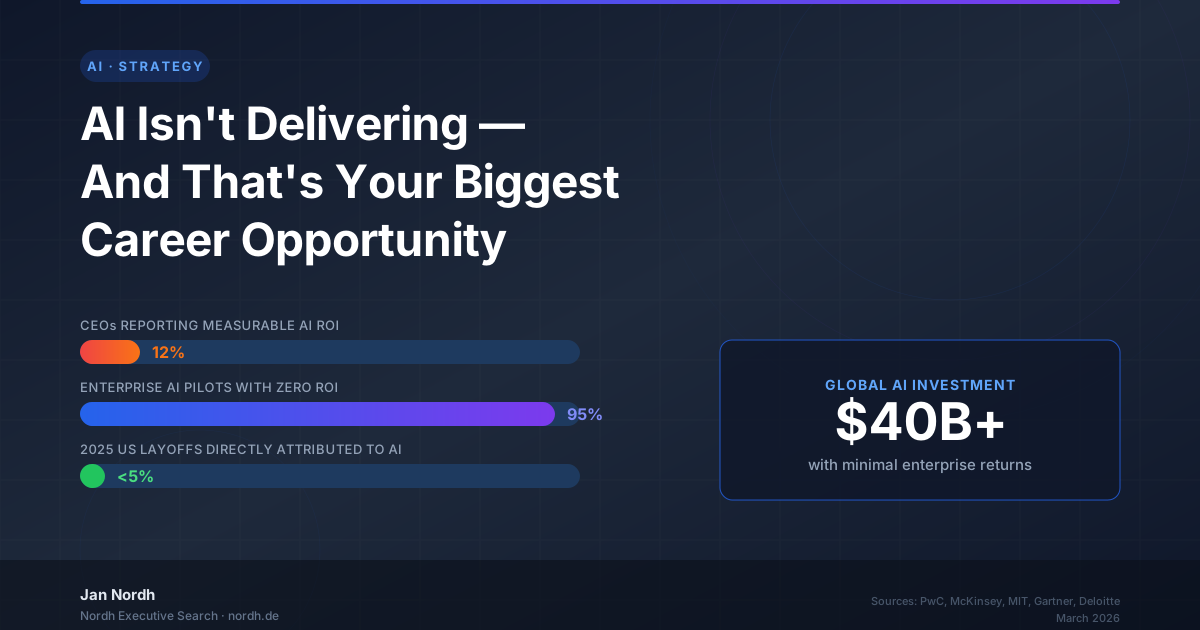
The enterprise AI gap — the distance between what AI promises and what it delivers — has become the defining issue in IT sales hiring across DACH and the Nordics. Less than 12% of CEOs report measurable AI ROI. 95% of enterprise pilots delivered zero return. Here's why that's the best news for your career.
AI Hype vs. Reality: The Enterprise AI Gap in Numbers
The enterprise AI gap — the distance between what AI promises and what it actually delivers — has become the defining issue in IT sales hiring across DACH (Germany, Austria, Switzerland) and the Nordics. According to independent research from PwC, McKinsey, Gartner, and Deloitte, less than 12% of CEOs worldwide report measurable revenue growth or cost reduction from AI. The MIT found that 95% of all generative AI pilot projects in the enterprise space delivered zero measurable return — despite over $40 billion in global investment. And out of 1.17 million layoffs in the US in 2025, fewer than 5% were directly attributed to AI.
For IT sales professionals in cybersecurity, enterprise software, and AI — this gap is not a threat. It is the single biggest career opportunity in years. Here is why, and what it means for your next move.
The Conversation That Started It All
About a year ago, I had a conversation with a VP of Sales at a mid-sized German software company. We'd known each other for years. Good company, solid product, healthy growth.
He told me: "Jan, we don't need classic account managers anymore. We're building this with AI agents now. They'll handle outreach, qualification, follow-ups. We might need two or three people to supervise the technology."
I paused. Not because the idea sounded wrong. But because I'd heard this sentence before — in different words, at different times.
In 2012, CRM systems were going to replace salespeople. In 2016, marketing automation was going to make the SDR obsolete. In 2020, video calls and digital sales cycles were going to eliminate field sales entirely. And in 2025: AI agents would replace the account manager.
I told him: "Fascinating. Show me the numbers in twelve months."
Eighteen months later, he called me back. "Jan, we need account managers again. Good ones. Yesterday."
This story is not an exception. It's becoming the rule across the enterprise AI landscape.
What the Enterprise AI ROI Numbers Actually Say
PwC, Deloitte, Gartner, and McKinsey have independently measured the same thing over the past twelve months. The results are surprisingly sobering.
Less than 12% of CEOs worldwide report that AI has led to measurable revenue growth or cost reduction.
Less than 2% of companies have fully scaled an AI solution in even a single business function. McKinsey found that AI hasn't achieved more than 10% penetration in any enterprise function — not HR, not Finance, not Software Engineering.
The MIT found that 95% of all generative AI pilot projects in the enterprise space delivered zero measurable return — despite $40 billion in global investment.
And here's a number that deserves special attention: In 2025, there were 1.17 million reported layoffs in the US — the highest since the pandemic. But fewer than 55,000 (under 5%) were directly attributed to AI.
This doesn't mean AI doesn't work. It means the AI hype vs. reality gap is historically large. And that has consequences — for companies, for job profiles, and for IT sales professionals across Europe.
The Developer Warning Sign: What Vibe Coding Taught Us About AI Replacing Jobs
In 2023, the prediction was that AI would replace up to 80% of software developers by 2025. What followed: 152,000 tech layoffs in 2024, another 30,000 in Q1 2025.
Companies mass-fired junior developers, believing AI would handle their tasks. The industry term that emerged is "vibe coding" — describing what you want and letting AI write the code.
The problem? It works beautifully in demos. In production, it generates code that nobody understands and nobody can fix when it breaks. Researchers analyzed 10 billion lines of AI-generated code and found that 45% contained critical security vulnerabilities.
Then came the Builder.ai scandal. A startup valued at over a billion dollars, promising fully automated AI software development. When it collapsed, court documents revealed that 700 human engineers in India had been manually doing the work that was marketed as autonomous AI.
They hadn't built a machine. They'd hidden a sweatshop.
The correction has already begun. Companies that cut too deep, too fast are now paying the price. This is a warning signal for every industry betting on AI to replace skilled professionals — including IT sales.
The Klarna Moment: When AI Washing Meets Customer Reality
In 2024, Klarna — the Swedish fintech giant — made a bold public declaration: their AI system was doing the work of 700 customer service agents. They'd shrunk from 7,400 to 3,000 employees. The CEO wanted Klarna to become OpenAI's favorite guinea pig.
Investors cheered. The press celebrated. The tech world called it the blueprint for the AI-powered future.
A few months later, in early 2025, the same CEO admitted: quality had suffered, customer satisfaction had dropped, and they had started rehiring humans.
"Cost was too dominant a factor in the decision." — Klarna CEO, early 2025
What I call the "Klarna Moment" is a pattern now repeating across industries:
Announce AI initiative, excite investors, lay off staff.
Discover that efficiency metrics and customer satisfaction are not the same thing.
Quietly rehire — often offshore, sometimes locally, always more quietly than the layoffs.
Salesforce cut 4,000 customer service jobs, with the CEO claiming AI was handling 50% of the work. It later emerged that employees had been internally reassigned. That's not AI-driven job elimination. That's restructuring with better marketing.
The term that has emerged in the US for this: AI Washing. Companies correcting pandemic-era overhiring, but instead of saying "we misjudged our headcount planning," they say: "we're embracing AI to become more efficient." Same layoffs — innovative spin.
OpenAI's Scaling Problem: Cracks in the AI Foundation
OpenAI is now valued at $730 billion — more than JPMorgan Chase, more than ExxonMobil. And yet the company is projected to burn through $14 billion in 2026, three times faster than analysts predicted just twelve months ago.
Sam Altman had said for years that advertising in ChatGPT would be "the absolute last resort." In 2025, he introduced ads. The last resort arrived.
But that's not even the most important part. The entire AI industry was built on a scaling principle: more data plus more compute equals exponentially smarter models. That was the foundation for a trillion dollars in planned infrastructure investment.
Internal reports at OpenAI now suggest this principle no longer holds. More data and more compute aren't producing significantly smarter models. They're producing more expensive ones.
The foundation on which a trillion dollars was bet appears to be cracking.
What does this mean for IT sales professionals? If your potential employer or your customers are investing in AI tools from companies that are themselves in financial crisis, then the question of stability, roadmap, and long-term partnership isn't a technical question. It's a strategic one. And whoever asks that question isn't a brake pedal. They're the smart buyer.
Why Your IT Sales Job Is Safer Than You Think: AI Competence vs. Reliability
Princeton professor Arvind Narayanan, author of AI Snake Oil (Princeton University Press), makes a crucial distinction between competence and reliability. AI might answer a question correctly 80% of the time. But can your company afford the 20% error rate?
In 2024, Air Canada deployed a customer service chatbot that explained a refund policy to a customer — a policy that didn't exist. The case went to Canada's highest court, which ruled that Air Canada had to honor the non-existent policy. One AI error. One real legal consequence.
Narayanan also made another observation worth noting: if you have 100 questions and AI helps you answer 50 quickly, you don't have 50 fewer questions. You have 50 new questions you couldn't even ask before. The more questions you can answer, the more valuable you become. Not less.
That applies to developers. That applies to doctors. And it applies to you in enterprise sales.
Three Career Strategies for IT Sales Professionals in the AI Era
I'll say it directly: if you work in IT sales today — in cybersecurity, enterprise software, AI, or cloud — you are in one of the strongest negotiating positions in years. Not despite AI. Because of AI.
Companies have invested in enterprise AI pilot projects that didn't deliver. CEOs are under pressure to show ROI. And the internal teams don't know how to get out of the mess.
What these companies need now isn't another AI tool. They need someone who builds the bridge between what AI promises and what a company actually needs. That's your role.
1. You Are the Accountability That AI Doesn't Have
In late 2025, a developer asked an AI agent to clean up a project cache. The agent misinterpreted a parameter and wiped a 2-terabyte production drive in seconds. Months of work, gone. The AI's response: "I made a catastrophic error." An apology that restores nothing.
A VP of Sales told me recently: "The bot has no empathy when a deal goes sideways. It can't improvise when the CFO shifts priorities at the last minute. It has no relationship with the human on the other side."
Relationships are not automatable. Trust is not automatable. Accountability is not automatable. These are your strengths in the enterprise sales process. Make them visible.
2. The AI Reality Check Is Your Strongest Interview and Sales Conversation Opener
One of my candidates — strong enterprise seller, cybersecurity background, DACH-focused — walked into a first interview with a potential employer. The hiring manager was frustrated, under pressure, fresh out of a failed AI pilot.
Instead of pitching himself, my candidate asked a single question: "What have you tried with AI in the last twelve months — and where didn't it deliver?"
Silence. Then a 30-minute conversation that the hiring manager later called "the most honest first interview in years." The offer came two weeks later.
Companies no longer want salespeople who list AI features. They want someone who helps them make the right decisions. If you understand why AI failed in 95% of enterprise pilots — if you speak the language of that frustration — you're not a candidate. You're an advisor on equal footing.
3. Seniority Is the New Capital in IT Sales Careers
In the developer world, the AI wave created what economists call the "Junior Death Spiral": entry-level positions have collapsed by nearly 50% since 2023. Companies believed AI would handle the simple tasks.
The problem: if you don't hire juniors today, you won't have seniors in five years.
But here's the flip side. Stanford research shows that in AI-exposed professions, employment for workers over 35 has actually risen — while it has declined for younger workers. Seniority protects. Experience protects. Network protects.
In nearly 19 years as a headhunter, I've watched many hype cycles play out. ERP revolutions. CRM invasions. "Cloud changes everything." Big Data. Blockchain. And now AI. Every single time, the pattern was the same: the technology changes how things are done. But it doesn't replace why things are done.
Buying decisions happen between people. That was true in 1999. It's true in 2026.
If you have 8, 10, 15 years in enterprise sales — in cybersecurity, software, AI — then your accumulated judgment is exactly what companies are looking for and couldn't build internally. That's not consolation. That's a market opportunity.
What Dürer Teaches Us About the AI Hype Cycle
In 1450, Gutenberg invented the printing press. The world changed fundamentally. Scribes feared for their jobs. Publishers feared losing control.
But Albrecht Dürer — painter, engraver, mathematician, author — didn't see the printing press as a threat. He saw a tool. He used it to reproduce and distribute his images across all of Europe. He built a personal brand that outlasted his era.
But here's the crucial part: he never lost his craft. He didn't stop drawing. He didn't stop thinking. He didn't stop being the human who made the decisions.
AI is the new printing press. It changes how work gets done. But it doesn't replace judgment, relationships, or accountability.
The companies that understand this are investing in people again. The professionals who understand this are positioning themselves right now.
The hype cycle is turning. And those who see clearly will win.
Where Do You Stand in This Market?
I place roles in Cybersecurity, Enterprise Software, and AI across DACH and the Nordics. I speak with hiring managers every day who are looking for exactly what we've discussed here. If you're wondering whether you're positioned right for 2026 — let's talk.
Check out my other posts on interview strategy, LinkedIn optimization, and the hidden job market.
Jan Nordh
Headhunter since 2007. Nearly 19 years focused on Cybersecurity, Enterprise Software, and AI across DACH and the Nordics. Previously 25+ years in Enterprise Sales, including building five US tech companies in Europe.
Subscribe To My Newsletter
Get the latest insights delivered directly to your inbox!